Building a Caring Life
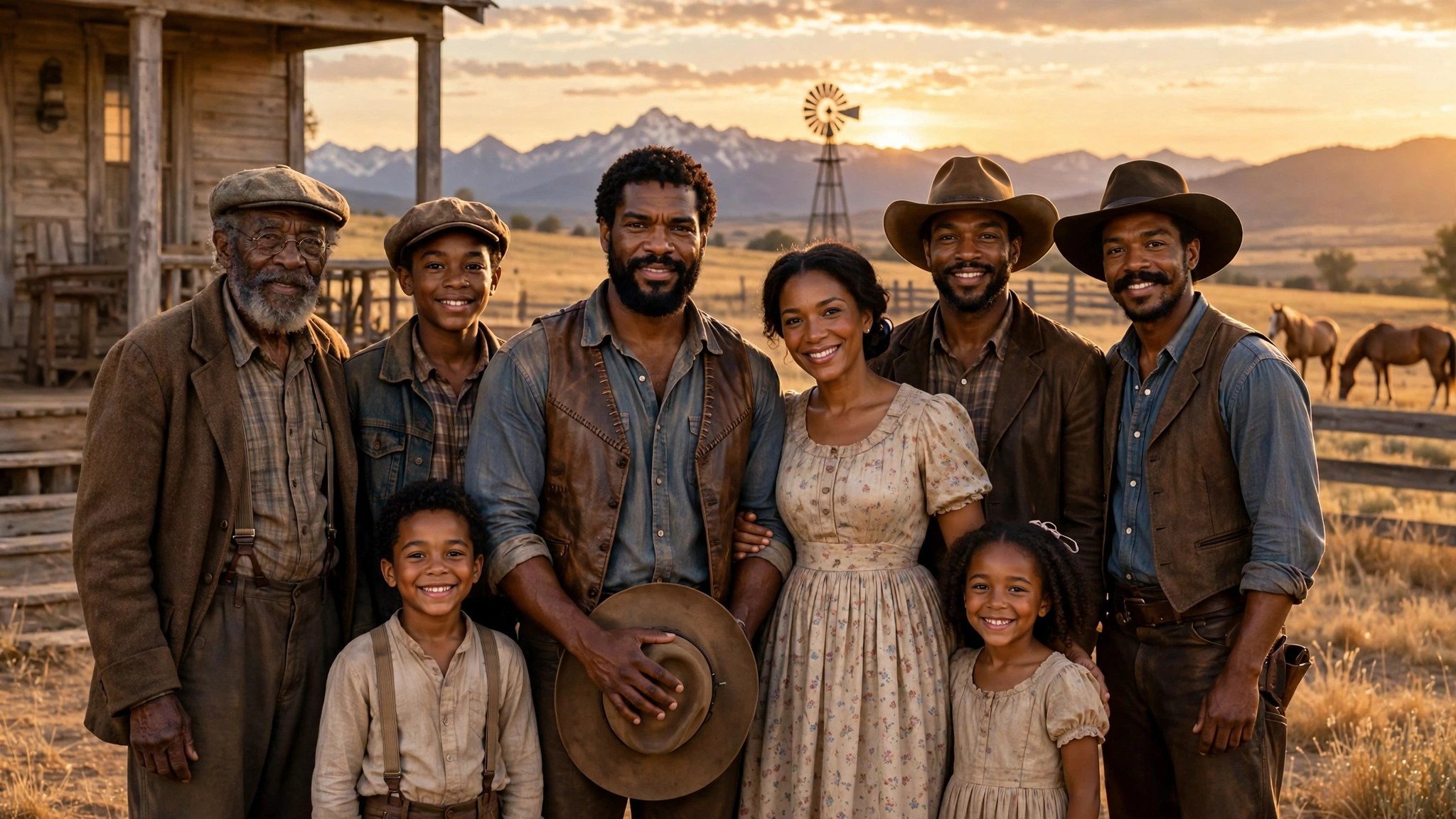
He was not the fastest gun or the loudest voice on the range. He was the man whose strength was spent on other people: water carried to an elder's door, fences mended before his own, a wagon pushed free, a church door held open with his hat in his hand. Nobody in need was ever passed by.
Servant, a J Ellington film coming Fall 2027, tells his story. It is a story this page exists to honor, because the history underneath it is real, and because the life he lived is still the pattern for a caring one.
Watch Servant, the full film, releasing Fall 2027. Watch on YouTube · Hear the full The Form (Servant) playlist
Begin Today starts with your free account.
The History Is Real
Black cowboys were a substantial share of the workforce that built the cattle era. Historians estimate that of roughly 35,000 cowboys who rode the trail drives, some 6,000 to 9,000 were Black, as many as one in four, with the strongest presence in Texas. That figure is an estimate, not a count, and it is the careful kind: the Library of Congress carries it because the surviving record supports it.
The craft itself began with the Spanish and Mexican vaqueros who first worked cattle in the Southwest. Enslaved Africans tended Texas herds through the Civil War, and after emancipation the ranches hired them as paid cowhands for the great drives north. They were among the most skilled riders on the trail, trusted with the hardest horses and the longest miles.
Discrimination set the boundaries of that life: the roughest work, a ceiling that kept most below trail boss, and exclusion from mainstream rodeo. Then popular culture finished the job, painting the cowboy as almost always white. The recovery of the true record began in earnest with Philip Durham and Everett L. Jones and their 1965 history, The Negro Cowboys. The record does hold real names, and they deserve to be said:
Nat Love
Born enslaved in Tennessee, he went west after emancipation and became one of the most celebrated Black cowboys of the trail era, known on the range as Deadwood Dick.
Bose Ikard
Charles Goodnight's most trusted hand on the Goodnight-Loving Trail, so valued that Goodnight later raised a granite marker over his grave in Weatherford, Texas.
Bill Pickett
The cowboy who created bulldogging, dropping a steer by its horns, a feat that became the steer wrestling event in rodeo to this day.
John Ware
Born enslaved in South Carolina, he drove some 3,000 cattle north to Alberta in 1882 and became one of the most respected ranchers in Canadian history.
Still Riding Today
This is not only a story about the past. The 2022 Census of Agriculture counted 46,738 Black producers working 5.3 million acres, with Texas first among the states, and 45 percent of Black-operated farms raising cattle or dairy. The life Servant lived is still being lived, in arenas, on trail rides, and in neighborhoods:
A Caring Life Is Built One Neighbor at a Time
Servant's life is the pattern. A caring life is not built in grand gestures. It is built in ordinary acts of service, repeated daily: water carried, fences mended, doors held, nobody passed by.
Building Caring is a Voice Up community where people practice exactly that, together. Begin today with a free account; your dashboard will walk you through the five steps, and a community will be there to walk with you.
Begin Today starts with your free account.
The Five Principles of Voice Up
This is how Voice Up has achieved what it has to date.
Building Caring is a Voice Up community. The man in Servant lived these principles long before they were written down: he worked alongside everyone, stayed humble, minded the details, forgave freely, and took the time to understand his neighbors. These five principles describe how we work.
Collaboration
Collaboration: all are welcome.
Humility
Humility: we all have much to learn.
Precision
Precision: all the details matter.
Patience
Patience: we all need forgiveness; we all make mistakes and learn from each.
Empathy
Empathy: we must understand your why.
Five principles, one way of working, practiced together in every Voice Up classroom, studio, and storefront.
Sources: Library of Congress (2022); Smithsonian Magazine (2017); Durham and Jones, The Negro Cowboys (1965); USDA National Agricultural Statistics Service, 2022 Census of Agriculture (2024); Glasrud and Searles (2016).